When Cloud Strategy Outpaces Network Reality: The Hidden Architecture Problem Costing Businesses Millions
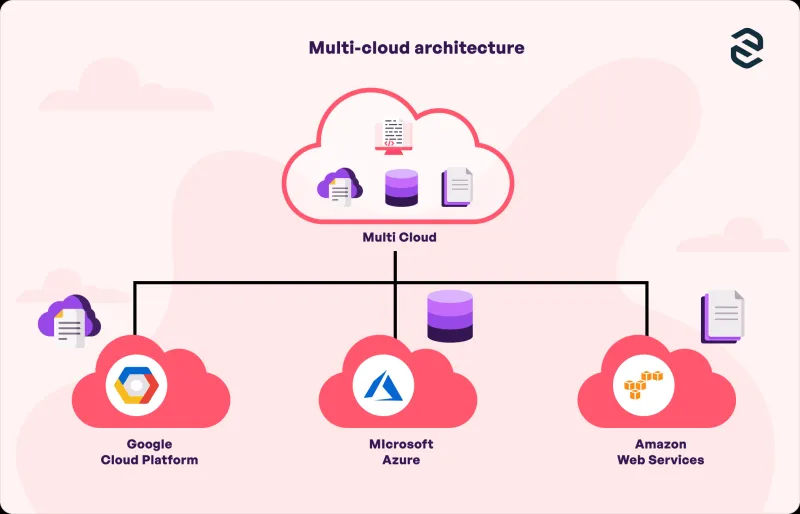
Photo: multi-cloud network architecture data center server infrastructure business, via www.fluence.network
The pitch for multi-cloud adoption is compelling on its surface: use AWS for compute, Azure for enterprise integrations, Google Cloud for analytics, and avoid vendor lock-in entirely. For many US businesses, this approach has become the default cloud posture—a hedge against dependency, a flexibility play, and a procurement strategy all rolled into one.
The problem is not the cloud strategy itself. The problem is what companies forget to redesign when they pursue it: the network.
In the rush to distribute workloads across providers, most organizations leave their underlying network topology largely untouched. The result is a mismatch between a sophisticated, distributed cloud model sitting on top of an infrastructure that was built for a different era—one where data lived in a single data center and users accessed it from a fixed office location. That mismatch does not stay invisible for long.
The Anatomy of a Multi-Cloud Bottleneck
When a business routes all inter-cloud traffic through a central on-premises hub—a legacy approach known as a hub-and-spoke topology—every packet traveling between cloud environments takes the long way home. Traffic from an AWS workload destined for an Azure database might traverse a physical data center in Ohio before reaching its destination in Virginia, adding latency, consuming bandwidth, and creating a single point of failure that negates much of the resilience multi-cloud was supposed to provide.
This is not a theoretical concern. A regional logistics firm headquartered in the Midwest discovered this pattern after migrating its order management system to AWS and its ERP platform to Azure. Within six months, finance was flagging unexpected data egress charges, operations was complaining about application slowdowns, and the IT team was spending significant hours troubleshooting connectivity issues that had no clean resolution within the existing architecture. The root cause was a network design that had never been updated to reflect where the data was actually living.
The fix required rearchitecting connectivity to allow direct, policy-controlled paths between cloud environments—effectively replacing the hub-and-spoke model with a mesh topology supported by a cloud-native networking layer. The transition took time and budget. Both could have been avoided with earlier planning.
Security Gaps That Multiply With Each Cloud Added
Beyond performance, multi-cloud environments create a security surface that expands with every provider added to the mix. Each cloud platform has its own identity and access management framework, its own logging conventions, and its own approach to network-level controls. When these environments are connected through an underpowered or poorly segmented network, the gaps between them become the most attractive targets for adversaries.
Consider the challenge of consistent policy enforcement. A firewall rule applied at the perimeter of an on-premises network does not automatically extend to traffic flowing between cloud environments. Without deliberate architecture decisions—such as deploying a cloud-native firewall service at each interconnect point or implementing a software-defined wide-area network (SD-WAN) with centralized policy management—security becomes a patchwork of controls that each cover only a portion of the actual traffic.
A financial services company operating in the Southeast learned this through a near-miss incident in which an attacker who had compromised credentials in one cloud environment was able to move laterally into a second because the inter-cloud traffic path lacked inspection. The breach was caught before data exfiltration occurred, but the remediation effort exposed just how much of the organization's network had been designed around a single-cloud assumption that no longer matched reality.
What Getting It Right Actually Looks Like
Businesses that successfully align their network architecture to a multi-cloud model share a few common characteristics. First, they treat network design as a first-order cloud decision, not an afterthought. Before selecting a second or third cloud provider, they assess how workloads will communicate, where latency will be introduced, and what the egress cost implications are of different connectivity patterns.
Second, they invest in technologies that abstract the complexity of multi-cloud networking. SD-WAN solutions with cloud on-ramp capabilities, cloud exchange services that provide direct, low-latency interconnects between providers, and centralized network observability platforms all serve this function. These tools do not eliminate the need for architectural discipline, but they provide the operational leverage to manage complexity at scale.
A professional services firm based in Texas offers a useful contrast to the cautionary examples above. When the organization expanded from a single-cloud AWS environment to include Azure for its Microsoft 365 integrations and a specialized SaaS analytics platform, the IT leadership team engaged in a deliberate network planning process before any workloads moved. They selected a cloud exchange provider that offered direct connectivity to both AWS and Azure from a shared point of presence, redesigned their WAN to route cloud-bound traffic locally rather than backhauling it through headquarters, and implemented a unified network monitoring solution that provided visibility across all environments from a single pane of glass.
The result was a multi-cloud environment that performed predictably, cost roughly 18 percent less in data transfer fees than their original estimates had projected, and gave the security team consistent visibility across every traffic path.
The Cost of Doing Nothing
For organizations that defer this work, the costs accumulate quietly at first and then suddenly. Egress fees that were not modeled in the original business case. Performance degradation that drives shadow IT workarounds. Security incidents that exploit the seams between environments. Engineering hours spent troubleshooting connectivity problems that are, at root, architecture problems.
The US market for cloud services continues to expand, and multi-cloud adoption is no longer a leading-edge strategy—it is mainstream. That means the businesses still operating on legacy network assumptions are not just behind on technology; they are carrying a structural disadvantage that compounds over time.
Aligning Architecture to Ambition
The path forward begins with an honest inventory. What workloads live in which cloud environments? How do they communicate, and through what network paths? Where is latency introduced, and where are security controls absent or inconsistent? These questions do not require a full infrastructure overhaul to answer, but answering them honestly is the prerequisite for any meaningful improvement.
From that baseline, organizations can prioritize the changes that deliver the greatest return—whether that is rerouting inter-cloud traffic through a direct exchange, deploying SD-WAN to enforce consistent policy across environments, or implementing centralized observability to surface problems before they become incidents.
Multi-cloud is not the trap. Building a cloud strategy on a network that was never designed to support it is. The distinction matters, and addressing it is among the highest-leverage investments a technology-forward business can make in 2025.