Edge Computing Is Already Here — And Most Business Networks Aren't Ready for It
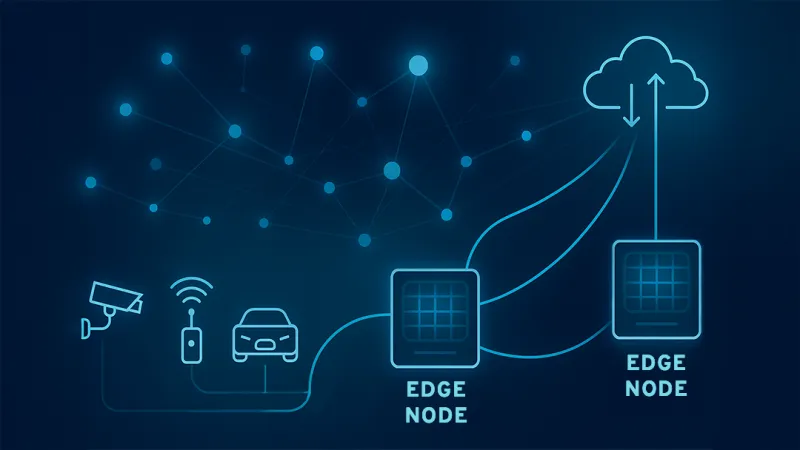
Photo: edge computing network infrastructure data center futuristic technology business, via a.storyblok.com
For the past several years, 5G has occupied the center of nearly every conversation about the future of enterprise networking. Carrier roadmaps, vendor marketing, and technology media have collectively framed fifth-generation wireless as the defining infrastructure shift of this decade. And while 5G is genuinely consequential — particularly for high-density environments, mobile workforce applications, and IoT deployments — treating it as a destination rather than a component of a larger architectural evolution is a strategic mistake.
The more disruptive shift is happening at the edge.
Edge computing — the practice of processing data closer to its point of origin rather than routing it to a centralized cloud or data center — is transitioning from an emerging concept to an operational reality across U.S. enterprise environments. According to IDC, global spending on edge computing infrastructure will reach $232 billion by 2025, with North American enterprises accounting for a substantial share of that investment. The organizations building edge-aware network strategies today are not early adopters chasing novelty. They are pragmatic operators responding to latency constraints, bandwidth economics, and data sovereignty requirements that centralized architectures simply cannot resolve.
This piece offers IT leaders a grounded perspective on what edge computing means for enterprise network design — and a practical roadmap for beginning the transition without disrupting current operations.
Cutting Through the Terminology
Few areas of enterprise technology suffer from more definitional ambiguity than edge computing. The term is applied to everything from on-premises micro data centers to content delivery nodes to ruggedized compute hardware bolted to factory floors. Before an organization can develop a coherent strategy, it needs a working vocabulary.
The edge refers, broadly, to any computing resource located outside a traditional centralized data center or public cloud environment — positioned closer to the users, devices, or systems generating and consuming data.
Near-edge infrastructure typically refers to regional data centers, carrier hotels, or colocation facilities positioned within a metropolitan area. These facilities reduce round-trip latency to the low single digits in milliseconds and are well-suited for latency-sensitive applications that do not require compute resources on-premises.
Far-edge infrastructure sits at or near the point of data generation — on a manufacturing floor, within a retail location, aboard a vehicle, or embedded in field equipment. Processing at the far edge enables real-time decision-making in environments where even 20 milliseconds of round-trip latency to a cloud platform is operationally unacceptable.
Multi-access edge computing (MEC) is a specific architecture, formalized by the European Telecommunications Standards Institute, that positions compute resources within or adjacent to cellular network infrastructure — enabling applications to leverage 5G connectivity while processing data locally.
Understanding where your applications and data flows fall within this continuum is the first step in determining where edge investment makes sense for your organization.
Why Centralized Architecture Has Reached Its Limits
The cloud-first model that defined enterprise IT strategy through the 2010s was built on a set of assumptions that are increasingly difficult to sustain.
The first assumption was that bandwidth is abundant and inexpensive. For many enterprise environments, this remains true for routine workloads. But organizations deploying high-resolution video surveillance, industrial sensor networks, or autonomous equipment are generating data volumes that make continuous cloud transmission economically and technically impractical. A single modern manufacturing facility can generate multiple terabytes of operational data per day. Transmitting all of it to a cloud platform for processing is neither cost-effective nor necessary — the vast majority of that data has value only in the moment it is generated.
The second assumption was that latency is a manageable constraint. For applications involving human interaction with software interfaces, a 50-to-100-millisecond round trip to a cloud data center is imperceptible. For applications involving machine-to-machine communication, automated process control, or augmented reality overlays on physical environments, that same latency is disqualifying. Autonomous vehicles, robotic surgery systems, and real-time quality control applications in manufacturing all operate on timescales that demand local processing.
The third assumption was that data can move freely across network boundaries. Regulatory frameworks including HIPAA, CCPA, and emerging state-level data residency requirements are placing meaningful constraints on where certain categories of data can be transmitted and stored. Edge architectures that process sensitive data locally — and transmit only aggregated or anonymized outputs — offer a structural solution to compliance challenges that cloud-first designs struggle to address.
The 5G-Edge Relationship: Complementary, Not Competitive
It would be a mischaracterization to position edge computing as a successor to 5G. The two technologies are architecturally complementary, and the most capable enterprise networks of the next decade will leverage both.
5G provides the high-bandwidth, low-latency wireless connectivity that makes far-edge deployments practical at scale. Without reliable, high-throughput wireless infrastructure, edge compute nodes at remote or mobile sites would be effectively isolated. 5G solves the last-mile connectivity problem that has historically constrained distributed computing architectures.
Edge computing, in turn, reduces the burden that would otherwise fall on 5G backhaul infrastructure. By processing and filtering data locally, edge nodes dramatically reduce the volume of traffic that must traverse the wide-area network — improving performance for all applications sharing that infrastructure and reducing operational costs.
IT leaders should resist the temptation to sequence these investments — completing a 5G deployment before considering edge, or vice versa. The most effective approach treats them as parallel workstreams within a unified network modernization program.
A Phased Transition Roadmap
The path to an edge-capable network architecture does not require a wholesale replacement of existing infrastructure. The following phased approach is designed to allow organizations of varying sizes and technical maturity to make progress incrementally.
Phase One: Assessment and Use Case Identification (Months 1–6)
Begin by auditing existing network architecture and application inventory. Identify workloads that are currently experiencing latency issues, bandwidth constraints, or data sovereignty complications in a centralized model. Prioritize use cases where edge processing would produce a measurable operational or financial benefit — not where it would simply introduce architectural novelty.
For small and mid-market organizations, Phase One frequently reveals that two or three high-value use cases — a latency-sensitive application, a data-intensive IoT deployment, or a compliance-driven data residency requirement — provide sufficient justification for initial edge investment.
Phase Two: Pilot Deployment and Architecture Validation (Months 6–18)
Select one or two priority use cases and deploy a limited edge infrastructure to support them. This may involve installing a compact edge compute appliance at a primary facility, engaging a near-edge colocation provider for regional compute capacity, or deploying a software-defined WAN solution that enables intelligent traffic steering between cloud and edge resources.
The objective of this phase is not scale — it is learning. Document latency improvements, bandwidth savings, and operational outcomes. Build the internal business case that will support broader investment in subsequent phases.
Phase Three: Scaled Deployment and Network Integration (Months 18–36)
With validated use cases and a tested architecture, extend edge infrastructure across additional sites and workloads. This phase typically involves deeper integration between edge compute resources and the organization's SD-WAN, security, and network management platforms. Automation becomes increasingly important at this stage — manually managing distributed edge nodes at scale is operationally unsustainable.
For enterprise organizations operating across multiple U.S. regions, Phase Three also involves decisions about near-edge colocation strategy — selecting regional data center partners that offer the geographic coverage, interconnection density, and carrier diversity needed to support a distributed architecture.
Phase Four: Continuous Optimization (Ongoing)
Edge infrastructure is not a deploy-and-forget investment. Application requirements evolve, data volumes grow, and new use cases emerge as operational teams become comfortable with the capabilities edge computing provides. Establish governance processes for ongoing use case evaluation, capacity planning, and security posture management across distributed infrastructure.
The Strategic Imperative
The organizations that will hold competitive advantages in connectivity-dependent industries five years from now are not waiting for edge computing to become mainstream before beginning to plan. They are making deliberate, phased investments today — building institutional knowledge, validating architectures, and developing the operational capabilities that distributed infrastructure demands.
5G is a powerful tool. Edge computing is the framework that determines how that tool is deployed. Together, they represent the infrastructure foundation of the next era of enterprise networking.
The businesses that treat network strategy as a reactive function — upgrading infrastructure only when current systems fail to meet demand — will find themselves perpetually behind. Those that invest in forward-looking architecture now will find that the edge was not a destination at all, but a competitive advantage they built before their competitors knew to look for it.
SuperNet Networks helps U.S. enterprises design and deploy future-ready network infrastructure, including SD-WAN, edge connectivity, and managed 5G solutions. Reach out to our technology consulting team to begin your edge readiness assessment.